
Several sensible picks can create an eye-catching payout, but the ticket is only as safe as its weakest leg.
A beginner might spot a favored basketball team, an in-form tennis player, and a football side with a strong home record. Taken separately, each wager offers a fairly modest return; combined in a parlay, the potential payout can suddenly look far more tempting.
Top Offshore Sportsbook Bonuses for September 2026





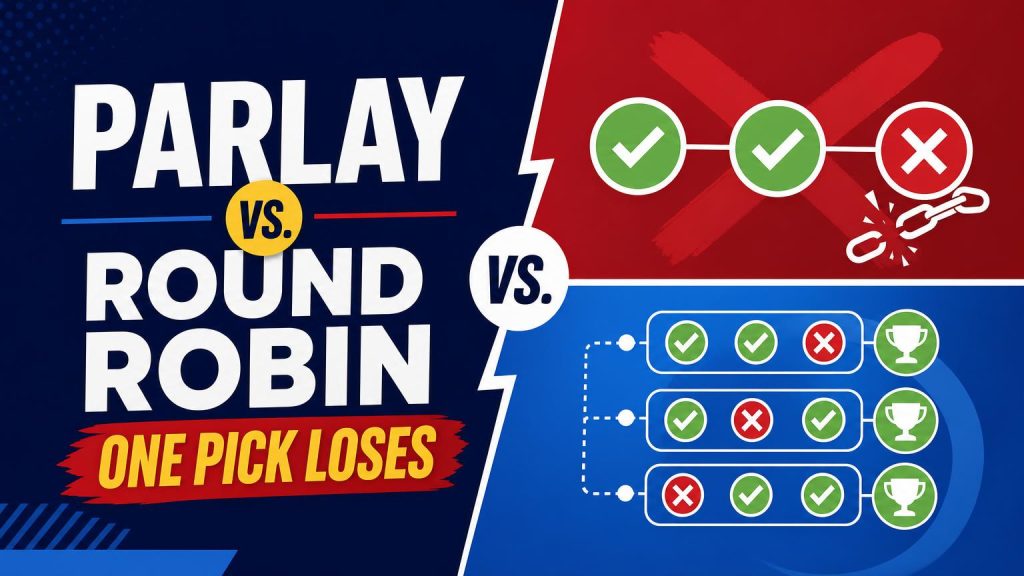
That bigger number comes with a hard rule: every selection must win. If the tennis player is upset, the whole parlay loses—even when the other two picks land. A parlay does not spread risk across several bets; it ties the results together. The stake is therefore exposed to every game, match, or outcome on the slip.
- A $10 three-leg parlay can return far more than three separate $10 bets, but one losing leg returns $0.
A Parlay Is One Bet Built From Several Selections
Parlay ticket
A parlay puts two or more selections onto a single betting slip. It carries one stake and settles as one overall wager, rather than as separate bets.
Leg
Each required selection is a leg. A ticket might have three legs: one team to win, one player to score, and an over/under total.
Market
A market is the type of outcome available for a game or event, such as moneyline, point spread, total, or player prop. The leg is the specific choice made within that market.
Selection
The selection is the exact pick, such as “Lakers moneyline” from the moneyline market or “Over 220.5” from the totals market.
Settlement
After every leg is decided, the sportsbook settles the ticket under its house rules. A voided or pushed leg is often removed and the odds recalculated, but policies vary.
A bettor could place $5 on a three-leg parlay:
Celtics to win — a moneyline market Over 214.5 points — a totals market A player to make 3+ threes — a player-prop marketThose are three legs, but only one $5 stake is placed. The ticket is not three individual bets; it has one combined result.
How the payout grows
Consider a two-selection parlay with a $10 stake. Suppose each selection is priced at decimal odds of 2.00—the equivalent of an even-money chance in that market.
The sportsbook multiplies the odds:
| Calculation | Result |
|---|---|
| 2.00 × 2.00 | 4.00 combined odds |
| $10 × 4.00 | $40 potential payout |
If both selections win, the ticket returns $40 total. That figure includes the original $10 stake, so the actual profit is $30. If either selection loses, the parlay loses and the $10 stake is not returned.
Why the figure can be misleading
A $40 potential payout can look far more appealing than two separate $10 bets. Yet the larger number does not mean the outcome is likely. With two roughly even selections, both must succeed; a simple rough illustration puts that at about one chance in four (50% × 50%), before allowing for sportsbook margin or changing market conditions.
The displayed payout answers only one question: how much would be returned if every leg wins? It is not a forecast, a promised profit, or an indication that the bet is a good value.
A useful habit is to check three numbers before placing a parlay:
- the total payout shown by the sportsbook;
- the profit, after subtracting the stake;
- the amount that is comfortable to lose if one selection misses.
Sportsbooks do not treat a parlay as a free-for-all menu. Before a ticket can be placed, the bet slip checks whether every selection is offered in that jurisdiction, still open for betting, and eligible to appear with the other legs. A market may also disappear after a line moves or an event begins.
The biggest restriction is correlation: two outcomes are connected strongly enough that one makes the other more likely. For example, a team winning and that same game going over the total can be related if a high-scoring performance helps produce the win. Simply multiplying the two standalone prices would usually overstate the potential return.
For that reason, a book may:
- reject the pair as “cannot be combined”;
- offer it only through a same-game parlay builder; or
- apply a different price that accounts for the relationship.
Rules vary by operator and sport, so a rejected ticket is not necessarily an error. The practical move is to check the bet slip’s message rather than assume a similar-looking market will qualify. For common questions about combining a team pick with the game total, the exact market matters. And when a builder accepts related legs, same-game parlay pricing works differently from regular parlays because the sportsbook has adjusted for that connection.
What an extra leg really changes
A third leg can make the displayed payout look much more attractive because decimal odds are multiplied again. For example, a $10 parlay with two 2.00 legs returns $40 if both win. Add a third 2.00 leg, and the possible total return rises to $80.
That larger figure comes with a stricter requirement: three results must now be correct, not two. A ticket can lose even when the original two picks win, simply because the added selection misses. The extra leg does not merely improve the payout; it creates another all-or-nothing condition.
A short-price favorite is often described as a “safe” addition, but no wager is guaranteed. Before adding it, compare the trade-off between a two-leg and three-leg ticket rather than focusing only on the headline return. If the third pick would not be worth betting on by itself, its modest odds boost may not justify the extra failure point.
Build and check the ticket
- Choose each market deliberately
Add only selections that are offered for that event and match the intended bet type. Confirm the event date, player, team, and market wording rather than relying on a shortened label.
- Check that the selections form one parlay
Open the bet slip and make sure every leg sits under the same parlay heading. If a sportsbook flags related outcomes or removes a leg, it may not allow that combination at the displayed price.
- Enter a stake that fits the risk
The amount entered is the full amount at risk, not an amount per leg. A small stake is often easier to evaluate while learning how a ticket settles.
- Inspect the combined odds and return
Read the total odds and estimated return before submitting; the return normally includes the stake. A parlay payout calculator can help compare a proposed ticket with one fewer leg.
- Review the final ticket
Recheck the number of legs, stake, odds, and any special conditions, then submit only if they match the plan. Save the confirmation so the settled result can be compared with the original selections.
Odds, eligible markets, and maximum stakes can move or disappear between adding a leg and submitting the ticket.
A sportsbook can refresh a price, reject a combination, or limit the stake before acceptance. Its posted house rules also determine how postponed events, voided legs, and player withdrawals affect a parlay. Reading those rules before placing the bet avoids treating an estimate as a guarantee.
When a leg does not settle normally
A parlay does not always end with every selection marked win or loss. A push—for example, a point spread landing exactly on the listed number—usually removes that leg and recalculates the ticket using the remaining selections. The stake does not automatically become a full refund; a three-leg parlay may simply be settled as a two-leg parlay. Details of how a pushed leg changes a parlay matter most when only two selections were on the ticket.
A void or cancelled market is commonly treated the same way: its odds are taken out, then the parlay price is adjusted. However, exceptions can apply to certain markets, promotions, and same-game parlays. If every leg is voided, the usual result is a returned stake.
Delayed games need a rule check
A postponement is less predictable because books set their own time windows. Some keep the leg active if the event resumes within a stated period; others void it once the original start date passes. For a postponed game on an existing parlay, the ticket’s status and the sportsbook’s settlement rules—not a general rule of thumb—decide the outcome.
Before placing the bet, checking the house rules for pushes, cancellations, and postponed events helps set realistic expectations.
What a cash-out offer means
A cash-out offer lets the bettor settle a live parlay before every leg has finished. Accepting it ends the ticket immediately for the displayed amount, whether later results would have produced a win or a loss. It is optional; leaving the offer alone keeps the original parlay active.
The figure is not the potential payout shown when the bet was placed. Sportsbooks continually estimate the ticket’s current chance of winning from live odds, remaining legs, score changes, injuries, and market movement, then typically build in a margin. This overview of how a parlay cash-out figure is calculated helps explain why an offer can be lower than an expected “fair” value.
Offers can disappear
Cash out is not guaranteed on every ticket or at every moment. It may be unavailable before a market starts, while odds are being updated, during a key play, or for certain bet types and suspended markets. A changing or missing button does not alter the parlay’s original settlement rules; common reasons an offer is unavailable are usually tied to the market rather than a ticket error.
Before accepting, compare the offered amount with the original stake and the still-possible return. The decision is a trade-off: guaranteed money now versus allowing the remaining selections to settle.
Parlay insurance has conditions
Parlay insurance is usually a promotion that refunds a qualifying bet when one leg loses. The refund may arrive as bonus credit rather than cash, and it may expire or require another wager before withdrawal.
Before treating an offer as meaningful, compare the rules at sportsbooks offering parlay insurance. Check the minimum number of legs, eligible sports and markets, maximum stake, refund cap, and whether a cash-out voids the promotion. A larger advertised refund can be less useful when its stake limit is small.
Insurance still leaves every other losing parlay unrefunded. It should never be a reason to add weaker legs or stake more than planned.
A “risk-free” label rarely means a guaranteed cash return. Confirm what is refunded, when, and how it can be used before placing the bet.
Round robins create several smaller parlays
A round robin takes three or more selections and turns them into every possible two-leg, three-leg, or other chosen-size parlay. Rather than one all-or-nothing ticket, it is a bundle of tickets. If one selection loses, some smaller parlays may still win; the way those combinations settle after a loss depends on the format.
That cushion is not free. Four picks in two-leg combinations produce six separate parlays, so a $5 unit risks $30—not $5. It is worth comparing a standard parlay with a round robin before choosing one. A round robin fits only when the full outlay is clear.
Make the final call
Before submitting, every leg should stand on its own—not merely improve the displayed payout. Risk only a stake that can be lost comfortably, and check the sportsbook’s settlement rules for pushes, voids, postponements, and cash-out. Keep the ticket number, selections, odds, stake, and a rules screenshot until it settles.
A round robin turns one idea into several bets; use a wager-count calculator to see the total exposure first. If added legs only make the ticket appealing, a smaller parlay—or no bet—is the better call.